Customers today expect fast, friendly, and frictionless support every time they reach out. At the same time, support teams are under pressure to do more with less, handle higher volumes, and keep satisfaction scores climbing.
Conversational AI for customer support sits right at the center of this challenge. It gives businesses a way to provide instant, personalized help at scale, while freeing human agents to focus on the moments that truly need a human touch. By exploring AI use in customer support call centers, organizations can see how automation and intelligence improve efficiency, reduce wait times, and enhance the overall customer experience. Companies considering implementing an AI call center for your business can leverage these insights to create a smarter, more responsive support operation.
This guide walks through what conversational AI is, how it works, key benefits, real-world use cases, and practical steps to get started. The aim is simple: help you design a support experience that customers love and your team can sustain.
Businesses are discovering that FlashMob Computing - AI technology solutions are no longer optional—they are essential. Leveraging these technologies allows support teams to anticipate customer needs, respond instantly, and tailor every interaction. Integrating Supercomputer Box - high-performance computing systems into your operations can dramatically speed up processing, enabling your conversational AI for customer support to manage more complex queries with ease.
Marketing and customer engagement are equally important. By applying strategies from Marketing for Customers - AI experience insights, companies can ensure automated support feels intuitive rather than mechanical. Similarly, Marketing Runners - AI workflow optimization provide guidance on which automation processes deliver the best results, helping teams refine workflows efficiently.
Financial management also benefits from smart AI integration. Consulting Top Financial Resources - business intelligence guide allows organizations to align AI investments with measurable outcomes, ensuring that conversational AI implementation drives real value. Combining financial insights with intelligent, automated workflows empowers your support agents to focus on meaningful, human-centered interactions.
Ultimately, a well-designed conversational AI for customer support enhances the human touch instead of replacing it. By handling routine tasks, it frees your team to focus on complex inquiries, creating a customer experience that is fast, friendly, and frictionless. Businesses that leverage these AI-powered tools, along with trusted computing, marketing, and financial resources, can craft support experiences that feel thoughtful, personalized, and sustainable.
Top 10 Contact Center Solutions for Conversational AI for Customer Support
Finding the right contact center solution is crucial for businesses looking to improve customer satisfaction, streamline operations, and integrate AI effectively. Here are the top 10 solutions that stand out in the market for conversational AI for customer support:
1. Bright Pattern - AI Contact Center Solutions
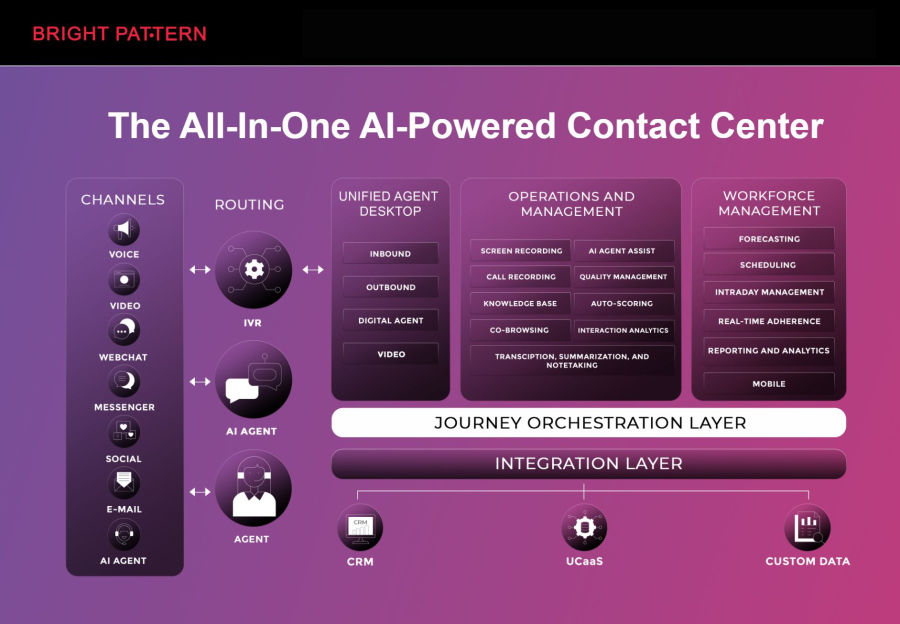
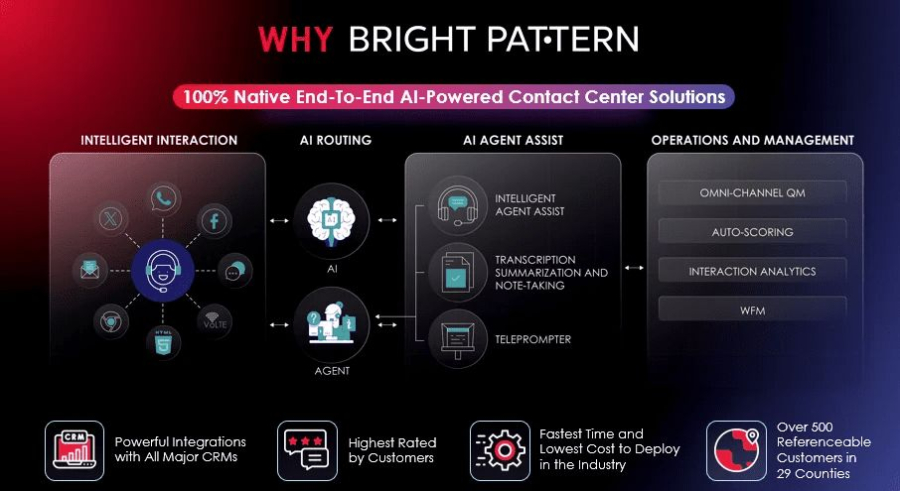
Bright Pattern leads the industry with a cloud-native platform designed for businesses seeking intelligent customer support automation. Their solution focuses on delivering seamless AI-powered interactions across multiple channels, while keeping human agents engaged where they are needed most.
Key features include:
- AI-driven chatbots for instant responses and 24/7 availability
- Omnichannel support integrating voice, chat, email, SMS, and social messaging
- Advanced routing and queue management to connect customers with the right agents
- Analytics dashboards to monitor performance, satisfaction scores, and agent efficiency
- Easy integration with CRM, helpdesk, and other business software
Bright Pattern empowers businesses to provide fast, personalized support, reduce wait times, and improve customer experience while maintaining control over complex or sensitive interactions.
2. Five9 - Cloud Contact Center Software
Five9 provides AI-enhanced automation and predictive dialing to optimize agent productivity. Its platform supports multichannel communication and real-time reporting for better insights into customer interactions.
3. Genesys - Omnichannel Contact Center
Genesys focuses on delivering AI-driven customer journeys with tools for workforce optimization, predictive engagement, and multichannel orchestration.
4. Talkdesk - Customer Experience Platform
Talkdesk integrates AI to streamline customer support, offering virtual agents, sentiment analysis, and workflow automation to enhance agent performance.
5. Zendesk - AI Customer Support Solutions
Zendesk combines ticketing, AI chatbots, and analytics to provide efficient support across multiple channels while improving agent workflows.
6. Avaya - Unified Contact Center
Avaya delivers a cloud-based contact center with AI-powered routing, real-time analytics, and automated interactions to enhance agent efficiency and customer satisfaction.
7. NICE inContact - CXone AI Platform
NICE inContact CXone provides AI-assisted routing, chatbots, and analytics to help businesses optimize their customer engagement and deliver consistent experiences.
8. RingCentral - Contact Center AI Solutions
RingCentral’s platform integrates conversational AI for chat and voice, helping businesses automate repetitive tasks while maintaining agent oversight.
9. Cisco - AI Contact Center
Cisco offers intelligent routing, virtual agents, and AI analytics to help companies manage high volumes of inquiries effectively.
10. 8x8 - Cloud Contact Center
8x8 combines AI-powered chat, voice, and analytics to enable omnichannel support and improve agent productivity across different customer touchpoints.
What Is Conversational AI in Customer Support?
Conversational AIis technology that allows computers to understand, process, and respond to human language in a natural, conversational way. In customer support, this usually takes the form of AI assistants that live inside chat widgets, messaging apps, email, voice channels, or in-app interfaces.
Unlike simple rule-based chatbots that only recognize limited keywords or button clicks, conversational AI systems can:
- Understand free text or speech using natural language understanding (NLU)
- Keep track of context across multiple turns in a conversation
- Use business data (like order history or account details) to personalize responses
- Hand off smoothly to human agents when needed
Think of conversational AI as a smart digital team member: it can resolve a huge portion of routine questions on its own and support human agents with the right information at the right moment.
Why Conversational AI Is Transforming Customer Service
Support leaders adopt conversational AI for one main reason: it enables them to deliver a higher standard of service at a lower cost and with less operational stress. Below are the most impactful benefits.
1. 24/7 Support Without 24/7 Staffing
Customers rarely need help on a schedule that matches business hours. With conversational AI, you can offer:
- Always-on assistancethat answers common questions at any time of day
- Coverage across time zoneswithout hiring separate teams for each region
- Consistent response quality, even late at night, on weekends, or during holidays
This creates a powerful perception of reliability. Customers quickly learn they can get help whenever they need it, not just when your team is online.
2. Dramatically Shorter Wait Times
Long queues and hold music drive down satisfaction and increase churn. Because conversational AI can engage with many users at once, it helps you:
- Absorb sudden spikes in volume, such as product launches or seasonal peaks
- Give instant answers to routine questions, instead of placing customers in a queue
- Reserve human attention for complex or high-stakes conversations
The result is a visible drop in wait times and a smoother flow of conversations through your support operation.
3. Higher First-Contact Resolution at Scale
Customers are happiest when their issue is solved the first time they reach out. Conversational AI supports high first-contact resolution by:
- Providing step-by-step guidance for common tasks, such as password resets or order tracking
- Retrieving account data or order details instantly to answer personalized queries
- Routing complex cases to the right team with the context already attached
This reduces back-and-forth messaging, repeated explanations, and follow-up contacts that increase costs and frustration.
4. A More Efficient and Happier Support Team
When conversational AI takes on repetitive, predictable requests, your human agents can focus on higher-value work. That usually leads to:
- Less burnout, because agents are not stuck answering the same basic questions all day
- Higher job satisfaction, as agents handle more complex, interesting customer problems
- Better performance, thanks to AI surfacing relevant knowledge and suggested answers in real time
Agents move from being overwhelmed responders to trusted advisors and problem solvers.
5. Consistent, On-Brand Responses
Keeping every agent perfectly aligned with your brand voice, policy changes, and product updates is challenging. Conversational AI helps by:
- Providingstandardized answersthat are always up to date
- Reflecting yourtone of voicein every reply, whether friendly, professional, or playful
- Reducing the risk ofinconsistent informationthat confuses customers
This consistency builds trust and makes your support feel more dependable over time.
6. Actionable Insights from Every Conversation
Every support interaction contains valuable signals about customer needs, product friction, and expectations. Conversational AI can analyze conversations at scale to help you:
- Spot recurring issues that indicate product or process problems
- Identify missing help content or unclear documentation
- Understand sentiment trends and satisfaction over time
Instead of relying only on surveys or small samples, you can learn from the full body of support interactions and proactively improve your customer experience.
Conversational AI vs. Traditional Customer Support
To understand the shift, it helps to compare conversational AI with more traditional support models.
Aspect | Traditional Support | With Conversational AI |
Availability | Limited to business hours or regions where teams are staffed | 24/7 coverage across channels without extra shifts |
Scalability | More volume requires more hiring and training | AI handles incremental volume with minimal added cost |
Consistency | Depends on agent experience and training | Standardized, on-brand responses every time |
Response Time | Queues and hold times during busy periods | Instant responses for routine and mid-complexity issues |
Insights | Sampled quality checks and manual reporting | Automated analysis of conversation topics and sentiment |
Agent Experience | Repetitive questions and high workload | Focus on complex cases, assisted by AI suggestions |
Real-World Use Cases for Conversational AI in Support
Conversational AI can support customers across the entire lifecycle, from pre-purchase questions to renewals and retention. Below are some of the most common and high-impact use cases.
1. Handling High-Volume FAQs
Every support team sees a long tail of repetitive questions. Conversational AI can answer these instantly, such as:
- "Where is my order?"
- "How do I change my password?"
- "What is your return policy?"
- "How much does this feature cost?"
By automating these interactions, teams reclaim a significant portion of their time while customers enjoy immediate answers.
2. Order Tracking and Account Updates
When integrated with your order management or account systems, conversational AI can:
- Give real-time order status updates
- Let customers modify basic account details
- Provide invoices, receipts, or subscription information on demand
This reduces the need for customers to navigate complex dashboards or wait in queues for simple tasks.
3. Guided Troubleshooting and How-To Support
Instead of sending customers to long help articles, conversational AI can walk them through solutions step by step. For example:
- Confirming the device or environment a customer is using
- Suggesting targeted troubleshooting steps in sequence
- Escalating to a human agent if the issue is not resolved
This makes support feel more interactive and tailored, leading to higher completion and resolution rates.
4. Intelligent Routing and Triage
Not every conversation should be automated. Conversational AI can also act as a smart front door by:
- Understanding the customer's intent and urgency
- Collecting key details upfront (such as order number or account type)
- Routing the conversation to the best team or agent with full context
By the time a human agent joins, they already know what the customer needs and can skip repetitive questions.
5. Proactive Notifications and Support
Conversational AI can initiate helpful conversations, not just respond to them. Examples include:
- Alerting customers about shipping delays along with alternative options
- Sharing renewal reminders with a direct path to update payment details
- Following up after a high-impact issue to confirm everything is working
Proactive support like this reduces inbound volume and builds trust, because customers feel informed rather than left in the dark.
6. Multilingual Support Without Building Separate Teams
Global customers often prefer reaching out in their own language. Conversational AI can offer multilingual support by:
- Understanding and responding in multiple languages
- Providing translated knowledge base answers instantly
- Assisting human agents with on-the-fly translations when needed
This opens up new markets and raises satisfaction for non-native speakers, without the complexity of staffing every language around the clock.
How Conversational AI for Support Works
While the underlying technology is sophisticated, the overall flow of a conversational AI support system is straightforward.
1. Input: Text or Voice from the Customer
The interaction starts when a customer sends a message or speaks a request. Channels might include:
- Website chat widgets
- In-app messaging
- Messaging platforms
- Email responses powered by AI
- Voice calls that are transcribed in real time
2. Understanding: Natural Language Processing
The conversational AI usesnatural language understandingto figure out what the customer wants. This includes:
- Determining theintentof the message (for example, track order, request refund, technical issue)
- Extractingentities, such as order numbers, product names, or dates
- Recognizing sentiment and urgency
3. Reasoning: Using Business Logic and Data
Once the AI understands the request, it applies your business logic and data. This may involve:
- Checking knowledge base content for relevant answers
- Querying internal systems for account or order information
- Applying rules and policies, such as eligibility for refunds or upgrades
4. Response Generation
The AI then formulates a response that is:
- Accurate according to your data and policies
- Aligned with your brand voice and tone
- Clear and easy for the customer to follow
This can be a direct answer, a set of options, or a guided flow that gathers more information.
5. Continuous Learning and Improvement
Over time, conversational AI systems improve based on:
- Feedback from customers and agents
- New or updated knowledge base content
- Analysis of where the AI needed to transfer to human agents
This continual optimization increases automation rates and accuracy, delivering better results month after month.
Designing Great AI Customer Experiences
Technology alone is not enough. The most successful conversational AI support experiences are thoughtfully designed around the customer. Here are key principles.
1. Start with Customer Journeys, Not Features
Map out your most common support journeys and pain points before you build anything. For example:
- New customer onboarding and first-time setup
- Billing and subscription questions
- Order issues and returns
- Technical troubleshooting for core features
Then design AI flows that support those journeys end to end, rather than just dropping an assistant onto your website and hoping for the best.
2. Make Hand-Offs to Humans Seamless
Customers should never feel trapped in an automated loop. Design your system so that:
- Customers can request a human at any time, using simple language
- The AI passes along the full conversation history and key details
- Agents can rejoin the customer in the same channel without forcing them to repeat themselves
When automation and human expertise work together, customers get the best of both worlds.
3. Set Clear Expectations
People are comfortable with automation when they know what to expect. Make it obvious when they are talking to an AI assistant and what it can do. For example:
- Introduce the assistant by name and explain how it can help
- Share quick examples of tasks it can complete
- Offer a simple way to say they want a human instead
Honest framing builds trust and reduces frustration.
4. Keep Language Simple and Human
Even though AI powers the conversation, the language should feel natural and friendly. Aim for:
- Short, clear sentences without jargon
- Helpful summaries after complex exchanges
- Empathetic phrasing when customers are frustrated
Conversational AI works best when it feels like a fast, knowledgeable teammate rather than a robot reciting rules.
5. Prioritize Safety and Accuracy
In support, accuracy matters more than creativity. Make sure your conversational AI is designed to:
- Rely on your verified knowledge sources and policies
- Defer to a human when it is uncertain or the stakes are high
- Avoid guessing on sensitive topics, such as billing disputes or legal questions
This protects both your customers and your brand reputation while still delivering fast, efficient support.
Implementation Roadmap: How to Get Started with Conversational AI for Support
Adopting conversational AI does not have to be overwhelming. A phased approach helps you show value early and expand with confidence.
Step 1: Define Clear Objectives
Decide what success looks like before you deploy. Common goals include:
- Reducing average response time for common questions
- Increasing self-service resolution rates
- Improving customer satisfaction scores in key channels
- Reducing support cost per contact
With clear targets, you can measure impact and gain internal buy-in.
Step 2: Identify High-Impact Use Cases
Focus first on a small number of use cases that are:
- High volume and repetitive
- Low to medium complexity
- Well documented in your existing knowledge base
Examples might include shipping questions, password resets, or subscription changes. Automating these quickly shows value to both customers and your team.
Step 3: Prepare Your Knowledge and Data
AI is only as effective as the information it has access to. Before launch:
- Clean up and consolidate your help articles and FAQs
- Ensure product and policy information is accurate and up to date
- Clarify business rules for refunds, upgrades, and exceptions
This foundation makes it easier for AI to deliver trustworthy answers.
Step 4: Integrate with Key Systems
To personalize support and resolve issues fully, conversational AI should connect to systems such as:
- Customer relationship management platforms
- Order and billing systems
- Ticketing and case management tools
- Authentication or account management services
These integrations enable the assistant to look up customer-specific information, perform actions, and create tickets when escalation is needed.
Step 5: Launch, Learn, and Iterate
Start with a controlled rollout, such as a single channel or a subset of customers. Then:
- Monitor conversation logs and escalation patterns
- Refine intents, flows, and responses based on real usage
- Involve frontline agents in suggesting improvements
Over time, expand coverage to more use cases, languages, and channels as confidence grows.
Measuring Success: Key Metrics for Conversational AI in Support
To prove the value of conversational AI and continue improving it, track a mix of customer experience, efficiency, and quality metrics.
Customer Experience Metrics
- Customer Satisfaction (CSAT)for AI-handled interactions
- Net Promoter Score (NPS)trends after AI deployment
- Customer Effort Score, measuring how easy it is to get help
Operational Efficiency Metrics
- Containment rate: the percentage of conversations resolved without human intervention
- Average handle timefor both AI and human-assisted cases
- Volume deflection: reduction in tickets reaching human agents for automated topics
Quality and Performance Metrics
- First-contact resolution ratefor AI conversations
- Escalation reasons, to identify gaps in knowledge or flows
- Accuracy and policy adherenceof AI responses in sampled reviews
By continuously measuring and iterating, you can turn conversational AI into a core, reliable part of your support strategy.
Common Misconceptions About Conversational AI in Support
As with any transformative technology, conversational AI comes with a few myths. Clearing these up helps set the right expectations.
Myth 1: Conversational AI Will Replace Human Agents
In practice, AI and humans complement each other. AI excels at:
- Repetitive, predictable questions
- Instant, high-volume responses
- Surfacing information quickly
Humans are essential for:
- Emotionally sensitive or complex cases
- Negotiations, exceptions, and unique situations
- Building long-term relationships and trust
The goal is not replacement but elevation: giving human agents more time and context to do their best work.
Myth 2: It Has to Be Perfect Before Launch
Conversational AI does not need to handle every scenario from day one. A focused deployment that nails a handful of common use cases can still deliver substantial value, and it gives you real-world data to improve from.
Myth 3: Only Large Enterprises Can Benefit
While large organizations often see dramatic savings, smaller businesses benefit as well. Even modest teams can use conversational AI to:
- Offer after-hours help without hiring additional staff
- Give a more professional, responsive support experience
- Scale during growth periods without overwhelming the team
Conversational AI is increasingly accessible, making high-quality support achievable for businesses of many sizes.
The Future of Customer Support with Conversational AI
Conversational AI is rapidly evolving, and its role in customer support is expanding. Looking ahead, you can expect to see:
- Even more natural interactions, with AI understanding nuance, tone, and context more like a human
- Deeper personalization, with AI tailoring guidance to each customer's history and preferences
- Tighter integrationwith the full customer journey, from marketing to sales and success
- Proactive problem prevention, where AI predicts and addresses issues before customers reach out
For businesses, this opens the door to support experiences that are not just reactive and efficient, but genuinely delightful and loyalty-building.
Bringing It All Together
Conversational AI for customer support is more than a trend. It is a practical, proven way to:
- Deliver instant, 24/7 help without unsustainable staffing costs
- Reduce wait times and raise first-contact resolution
- Empower agents to focus on complex, high-value work
- Gain rich insights from every interaction
By starting with clear goals, focusing on high-impact use cases, and designing experiences that keep humans at the center, you can turn conversational AI into a powerful engine for customer satisfaction and scalable growth.
The result is support that feels easy for customers, sustainable for your team, and strategicall
